Baseline contains condition differences
Symptom. Effect flips sign when the baseline window moves.
1 claim on this page is unverified. TODO(confirm) marks a specific statement the author has not yet checked against a
primary source. Everything else on this page has been reviewed. Treat a marked claim as
provisional and go to the cited source rather than quoting the sentence.
Symptom
The effect changes size — or reverses — when the baseline window is moved, while nothing else in the pipeline changes. The un-baselined condition averages are already separated before the stimulus. A component appears with the “wrong” polarity, or an effect that was clear in one lab’s analysis is absent in another’s, and the two analyses differ only in their baseline interval. In a cued or blocked design, the effect is largest in exactly the conditions whose pre-stimulus interval was manipulated.
Cause
Baseline correction subtracts one constant — the mean over the baseline interval — from every sample of the epoch, separately for each trial and each channel. If the conditions differ during that interval, a different constant is subtracted in each condition, and the difference reappears across the whole rest of the epoch with its sign reversed:
measured effect(t) = true effect(t) − effect(baseline interval)So a pre-stimulus difference of +2 µV subtracts 2 µV from the measured effect at every post-stimulus latency. When the true effect is smaller than the baseline difference, the measured effect inverts.
There are several ordinary ways for the baseline to acquire a condition difference, and none of them is a mistake in the recording:
- A slow potential that starts before the stimulus. Anticipation, preparation and cue-related negativity are real and are exactly what a pre-stimulus interval contains in a cued design.
- Overlap from the preceding trial. When the interval between events is short or the conditions differ in their preceding context, the tail of the previous response sits inside the baseline (L3.1).
- Block or order structure. If conditions are blocked, slow drift, arousal and electrode state all differ between conditions during the baseline as well as after it.
- Unequal trial counts or unequal noise. The baseline mean is an estimate; a condition with fewer or noisier trials has a noisier baseline estimate, and with a short baseline that noise is added to every sample of the epoch.
The second mechanism is quieter and worth stating separately: baseline correction is not free even when the assumption holds. Subtracting an estimated mean adds that estimate’s variance to every sample, so a short baseline makes the whole epoch noisier.
Detect
- Plot the un-baselined averages. This is the whole diagnosis. If the conditions are separated before the stimulus, the assumption behind the subtraction is false, and the measured effect is a difference of differences.
- Measure in the baseline. Run the same statistical test on the mean amplitude of the baseline interval itself. A significant condition difference there is the problem, stated as a number.
- Move the window and report the sensitivity. Recompute the effect with two or three baseline intervals fixed in advance — a longer one, a shorter one, one placed earlier. An effect that changes materially is telling you which quantity you are measuring.
- Check the preceding trial. Sort by the identity of the previous trial and by the interval since it; a baseline contaminated by overlap varies with both.
- Check trial counts and noise per condition, and report the standardized measurement error (L3.5). A baseline difference that is really a noise difference has a different fix from one that is really a slow potential.
Fix
- Fix the baseline interval before you look at the effect, and report it. Sensitivity analyses are a check on a pre-specified choice, not a menu.
- Move the baseline to an interval the manipulation cannot reach — before a preceding cue, or before the trial’s condition is knowable to the participant. In a cued design this is usually possible and is the cleanest fix.
- Model the baseline instead of subtracting it. Regress the post-stimulus amplitude on the baseline mean rather than assuming a coefficient of one; the regression removes the part the baseline actually predicts and leaves the rest (L3.1, L3.6, L6.2).
- Deconvolve the overlap when the contamination comes from the preceding trial, or jitter the interval at design time so it averages out (L3.5).
- Report the pre-stimulus difference rather than hiding it. If the conditions genuinely differ before the stimulus, that is a finding about anticipation or preparation, and subtracting it is discarding data, not cleaning it.
- Use a long enough baseline that its own noise is small relative to the effect, subject to it not reaching into the preceding trial.
Example
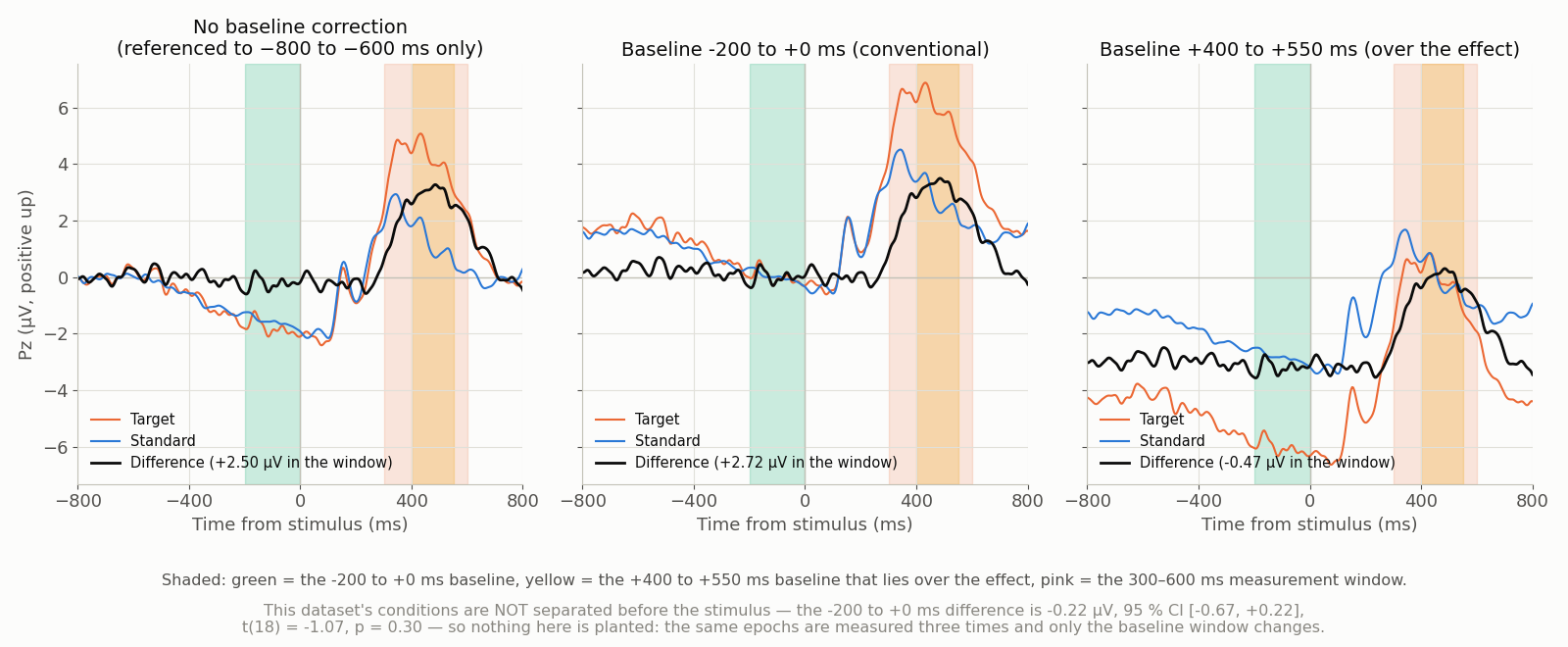
TODO(confirm): caption and numbers, once data/scripts/make_figures_p2.py has written /figures/pitfalls/pf-baseline-contamination.png and its sidecar — including the subject or grand average used, the two baseline intervals, the measurement window, and the mean amplitude of the difference wave under each baseline. The figure is generated from the same ds-erpcore P3 epochs that w-epoch-builder serves (CC BY 4.0; derived: epoched, re-referenced, resampled). The description above states what the mechanism requires the figure to show; the sidecar’s own alt and caption are the authority once it exists.