Hardware notch or band-limit inside the analysis band
Symptom. Spectral hole at 50/60 Hz or a roll-off at 40–50 Hz mistaken for a physiological dip; double-notching in software.
Symptom
A resting spectrum with a sharp hole at 50 or 60 Hz although no software notch was applied; a “gamma decrease” or “beta peak” that is really the shoulder of a hardware low-pass; a spectral-parameterization fit whose aperiodic exponent is wrong because the fit range crosses a hole or a roll-off; a second notch applied in software to a line that was already removed, creating a wider hole. Datasets in the directory that carry a hardware notch include ds-arithmetic (50 Hz notch plus a filter its descriptor calls a “30 Hz cut-off”) and ds-chbmp (60 Hz notch online); the consumer-headset sets in §10.4 have built-in 50 and 60 Hz notches; ds-bonn has a 0.53–40 Hz hardware band-pass and no notch hole.
Cause
Amplifiers and headsets can apply filters before the data are stored: a notch at the mains frequency, a low-pass well below the Nyquist frequency, a high-pass. These are recorded in the file header at best and in the device documentation at worst. Once applied they cannot be undone, and they shape every spectrum computed from the data. An analyst who does not read the hardware fingerprint interprets the shape of the filter as the shape of the brain.
Detect
- Read the header and the dataset descriptor for online filters before computing anything; record them in the first-look report (L0.6).
- Compute a PSD on a long, quiet segment up to the Nyquist frequency and look for: a narrow hole at 50/60 Hz, a knee where the spectrum starts falling faster than the aperiodic trend, and a floor.
- Check whether the hole or knee is identical across all channels and subjects — physiology varies, hardware does not.
- If a spectral-parameterization fit has a poor residual near the edges of the range, the range crosses a hardware feature.
Fix
- Restrict the analysis band to the hardware passband: fit aperiodic models and report band power only below the low-pass knee and away from the notch.
- Do not notch again in software; exclude the notch bins from fits and from any narrow-band measure.
- State the hardware filters in the methods, alongside the software filters.
- When comparing datasets or devices, compare only within the common passband; a device with a 43 Hz ceiling cannot be compared with a research amplifier above that (see pf-hardware-bandwidth-ceiling).
Example
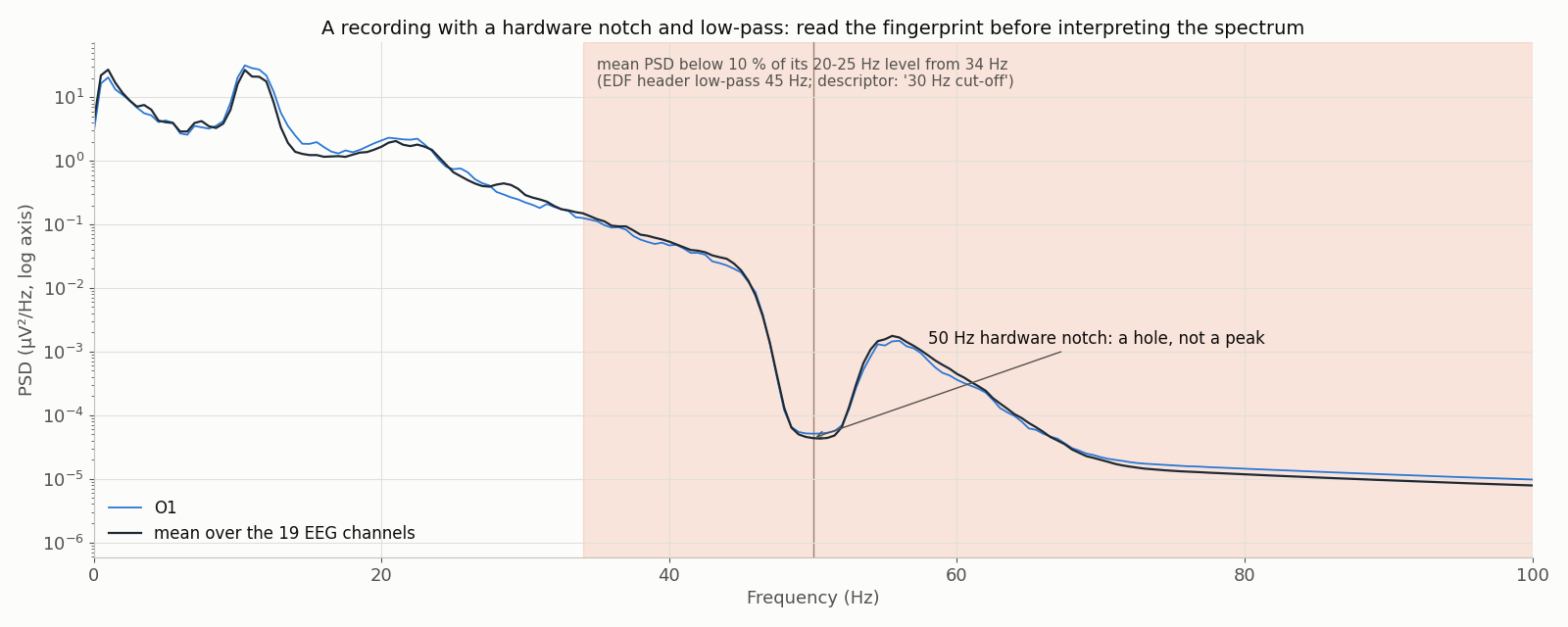
ds-arithmetic Subject00_1 (eyes-closed background recording, 500 Hz, 182 s; EDF header high-pass 0.5 Hz, low-pass 45 Hz); Welch PSD, 2-s Hann segments. The 50 Hz hardware notch leaves a hole (power at 50 Hz about 5% of its 47–53 Hz neighbours) rather than a mains peak, and the hardware low-pass rolls the spectrum off well below the 250 Hz Nyquist frequency. Both must be read from the acquisition metadata, not mistaken for physiology; the ds-eegbci comparison with no hardware filters is in the hardware-bandwidth pitfall. Generated by data/scripts/make_figures.py (ODC-By 1.0).