Electrode bridging
Symptom. Two neighbouring channels are near-identical; interpolation "works".
1 claim on this page is unverified. TODO(confirm) marks a specific statement the author has not yet checked against a
primary source. Everything else on this page has been reviewed. Treat a marked claim as
provisional and go to the cited source rather than quoting the sentence.
Symptom
Two (or more) neighbouring channels carry nearly the same trace, including the same noise, so their difference is close to zero over the whole recording. Each channel looks healthy on its own: normal amplitude, normal spectrum, nothing flagged by a variance or amplitude check. Topographies show a flat patch between the two sites; a Laplacian or bipolar derivation between them is empty; an interpolation of one from its neighbours reproduces it almost perfectly, which looks like success and is in fact the symptom. In a high-density recording several bridged pairs can appear, especially in a cap that was over-gelled.
Cause
Conductive gel spreads between two neighbouring electrodes and connects them electrically, so both record the same potential. It is most common with dense caps (short distances), with too much gel, with sweating, and with long recordings in which gel migrates. Because bridged channels are not noisy, the usual bad-channel detectors, which look for variance, amplitude or spectral outliers, do not see them; only a check of similarity between channels does. The result is a montage that has silently lost a channel and gained a duplicate, which biases the average reference, distorts topographies and interpolation, and makes any spatial method (CSD, ICA, source estimation) treat one signal as two.
Detect
- Compute the electrical distance between every pair of channels (the variance of their difference signal over the recording); bridged pairs stand out as near-zero values in an otherwise broad distribution. MNE provides
mne.preprocessing.compute_bridged_electrodesfor this check (TODO(confirm) the citation for the electrical-distance method the author wants listed in the reading list). - Look at a correlation matrix between channels ordered anatomically: a correlation near 1 between neighbours that is far above the surrounding values is a bridge.
- Plot the difference between each pair of adjacent channels on a bipolar chain: a flat trace where there should be signal is a bridge.
- Check the impedance log from the recording: very low, nearly equal impedances at two neighbours are suspicious.
Fix
- At acquisition: use less gel, check impedances for suspiciously low neighbouring pairs, and re-prepare bridged sites before recording.
- Offline: mark bridged channels as bad before computing an average reference, interpolating, or running ICA; if both channels of a pair are bridged to each other, keep one and interpolate the other only from unbridged neighbours, or drop the pair.
- Keep the bridge in the QC log and in
_channels.tsv(status,status_description) so that the decision travels with the data. - Never let “interpolation reproduces the channel” count as evidence that the channel is good; for a bridged channel that is exactly what is expected.
Example
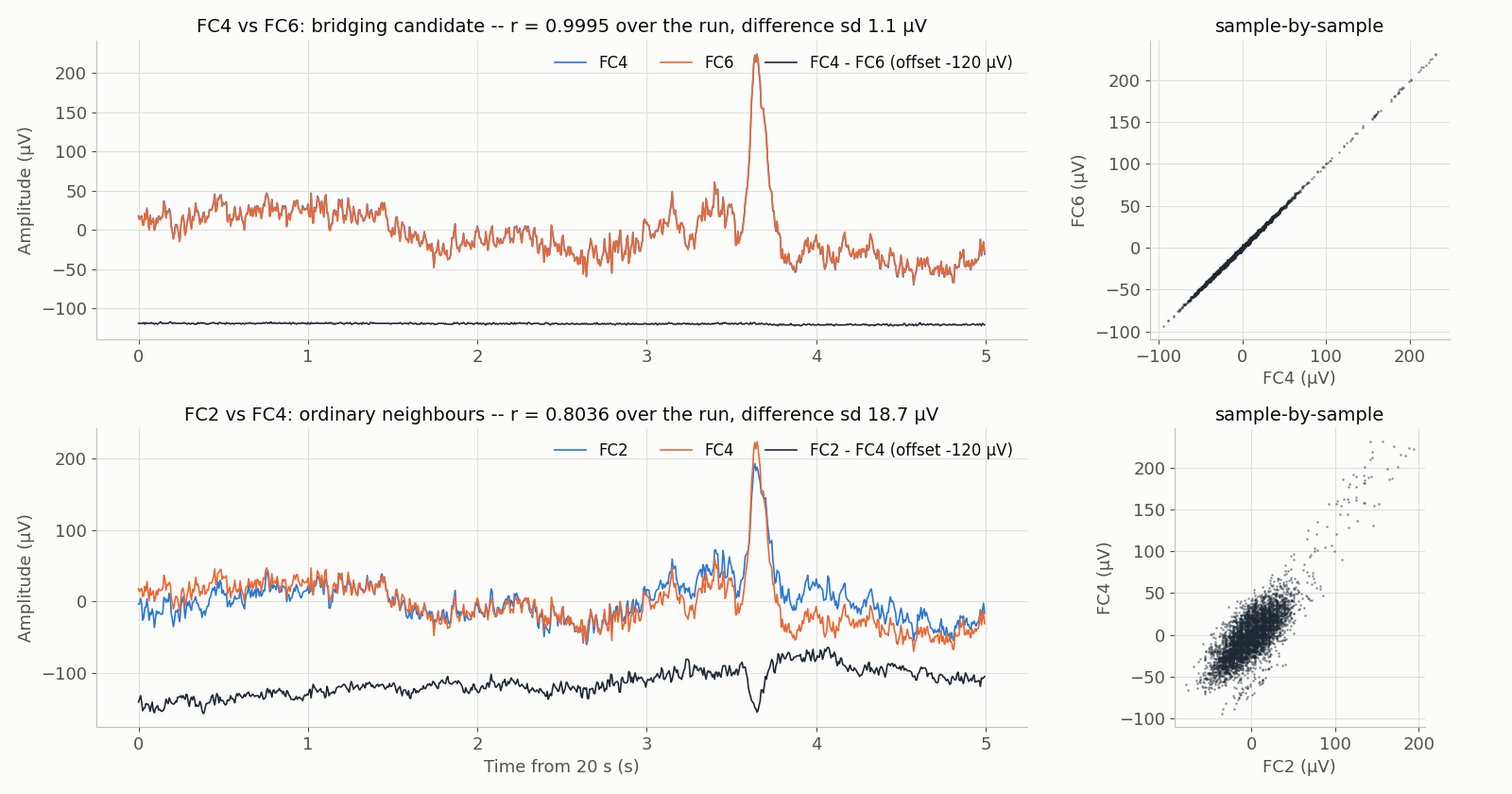
ds-eegbci S004 R01 (eyes open, 160 Hz), a 5-s excerpt from 20 s. FC4 and FC6 correlate at r = 0.9994 over the whole run (difference sd 1.1 µV) where the ordinary neighbouring pair FC2/FC4 reaches r = 0.80 (difference sd 18.7 µV). Near-identical neighbours are the signature of a bridge; this pair is an algorithmic candidate flagged in Phase 0 (label_source: algorithmic) and awaits the author’s review. Generated by data/scripts/make_figures.py (ODC-By 1.0).