Eye movements contaminate lateralized effects
Symptom. N2pc / lateralized gamma tracks HEOG.
1 claim on this page is unverified. TODO(confirm) marks a specific statement the author has not yet checked against a
primary source. Everything else on this page has been reviewed. Treat a marked claim as
provisional and go to the cited source rather than quoting the sentence.
Symptom
A lateralized effect — a contralateral-minus-ipsilateral difference such as the N2pc, a lateralized readiness potential, or lateralized “gamma” — whose amplitude and time course follow the horizontal EOG. The effect is largest at lateral frontal sites, grows with the eccentricity of the target, and shrinks or disappears when trials with horizontal eye movements are removed.
Cause
The eye is a dipole with the cornea positive. A horizontal saccade toward a lateral target moves that dipole so that electrodes on the side the eye moves toward go positive and those on the other side go negative (L0.5). Because a lateralized ERP is computed as a difference between hemispheres, an eye movement that is systematically toward the target produces a difference wave with a clean lateralized topography — the signature of the effect you were looking for, with a stimulus-locked onset that matches saccade latency. Small saccades of a degree or less are enough to matter at the amplitudes of typical lateralized components and are invisible without an EOG channel or eye tracker.
Detect
- Plot the HEOG (or F7 minus F8) averaged the same way as the effect (contralateral minus ipsilateral): any residual lateralized deflection in that average is a confound.
- Compare the time course and topography of the effect with the HEOG average; an eye-movement confound is largest at the most lateral frontal sites and falls off toward the midline.
- Split trials by whether a saccade was detected (step-function detector on HEOG, or eye tracker) and check that the effect is present in the saccade-free trials.
- Check whether target eccentricity predicts effect size across conditions.
Fix
- Record EOG (or eye-track) and reject trials with horizontal eye movements above a stated threshold, applied identically across conditions (L2.5).
- Use a step-function artifact detector on HEOG rather than a simple amplitude threshold, because small saccades are steps, not spikes.
- Correct with ICA or EOG regression and verify on the residual HEOG average that no lateralized deflection remains (L2.6).
- Design: keep targets close to fixation, enforce fixation, and report the residual HEOG amplitude in the methods.
Example
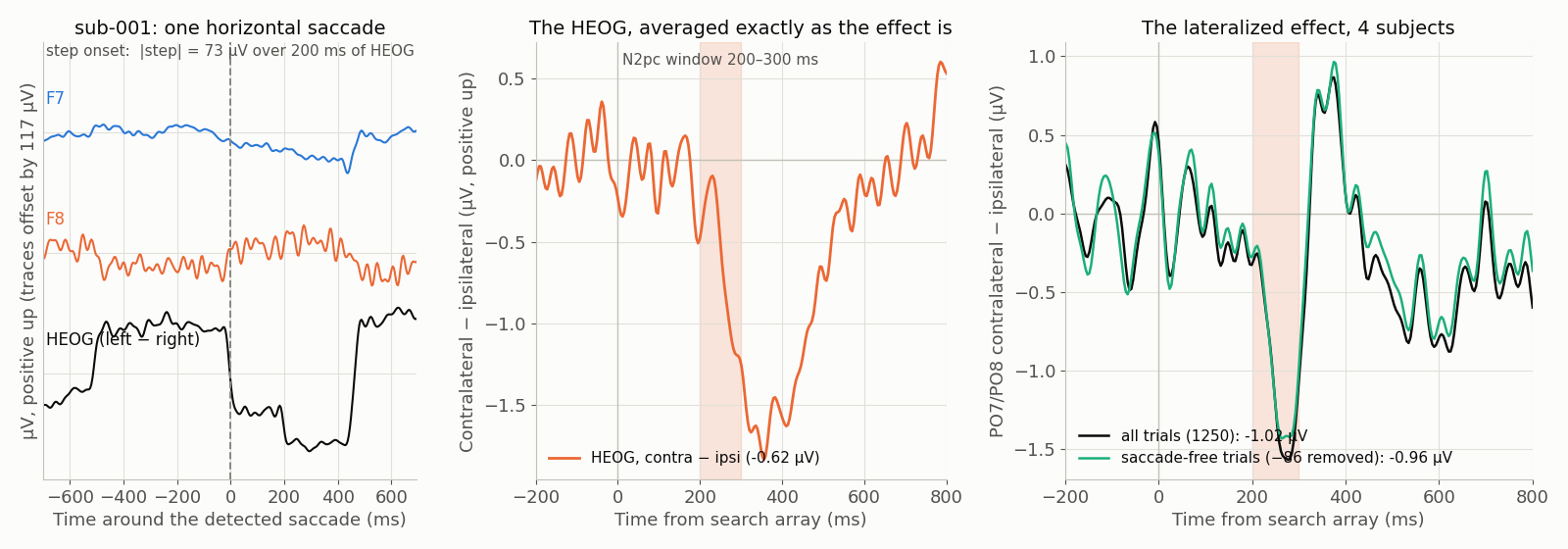
TODO(confirm): caption and numbers, once data/scripts/make_figures_p2.py has written /figures/pitfalls/pf-eye-movements-lateralized.png and its sidecar — including the dataset, subject and segment used, the electrodes plotted, the saccade-detection criterion and the number of trials it removed, and the amplitude of the residual lateralized HEOG deflection. The site’s EOG-bearing sources are ds-lemon raw (which has VEOG) for the raw-segment panel and ds-erpcore (30 EEG + 3 EOG) for the averaged panels; the sidecar records which was used. The description above states what the mechanism requires the figure to show; the sidecar’s own alt and caption are the authority once it exists.