Usable bandwidth far below the Nyquist frequency
Symptom. "Gamma" analysed at 128 Hz output from a headset whose hardware rolls off near 43 Hz; a 500 Hz recording with a ~30 Hz hardware low-pass.
Symptom
An analysis of frequencies that the recording cannot contain: gamma band power from a device whose hardware bandwidth ends near 43 Hz although it outputs 128 or 256 Hz samples (the consumer headset behind the §10.4 datasets); beta or gamma from ds-arithmetic, nominally 500 Hz but with a hardware filter its descriptor calls a “30 Hz cut-off”. Results in the affected band are small, flat, uniform across subjects and conditions, and dominated by the noise floor — or by whatever the filter’s roll-off happens to look like.
Cause
The sampling rate sets the Nyquist frequency (half the rate), which is the highest frequency the file could represent. It says nothing about the highest frequency the amplifier passed. Anti-alias and other hardware low-pass filters sit well below Nyquist by design; consumer devices decimate from a high internal rate after a low-pass that ends far below the output rate. The band between the hardware ceiling and Nyquist contains only attenuated signal, quantization noise and whatever leaks through the filter’s stopband.
Detect
- Read the device specification and the dataset descriptor for hardware bandwidth, not just the sampling rate.
- Compute a PSD up to Nyquist on a quiet segment: a knee after which the spectrum falls steeply, then flattens onto a floor, marks the ceiling. The knee is at the same frequency in every channel and every subject.
- Check that the spectrum above the knee shows no physiology: no reactivity to condition, no topography.
- Compare with a research-amplifier recording of the same paradigm where possible; a band that shows an effect in one and nothing in the other is above the ceiling of the other.
Fix
- Restrict every analysis to the hardware passband and state that passband in the methods.
- For decimation and resampling, the anti-alias filter must sit below the new Nyquist frequency (L1.1) — and the usable band is still bounded by the hardware ceiling, whichever is lower.
- When a research question needs a band the device cannot deliver, change the device, not the analysis.
- Teach it as a fact from the directory (L7.5): device class, bandwidth, notches, channel count — never as a judgment of a product.
Example
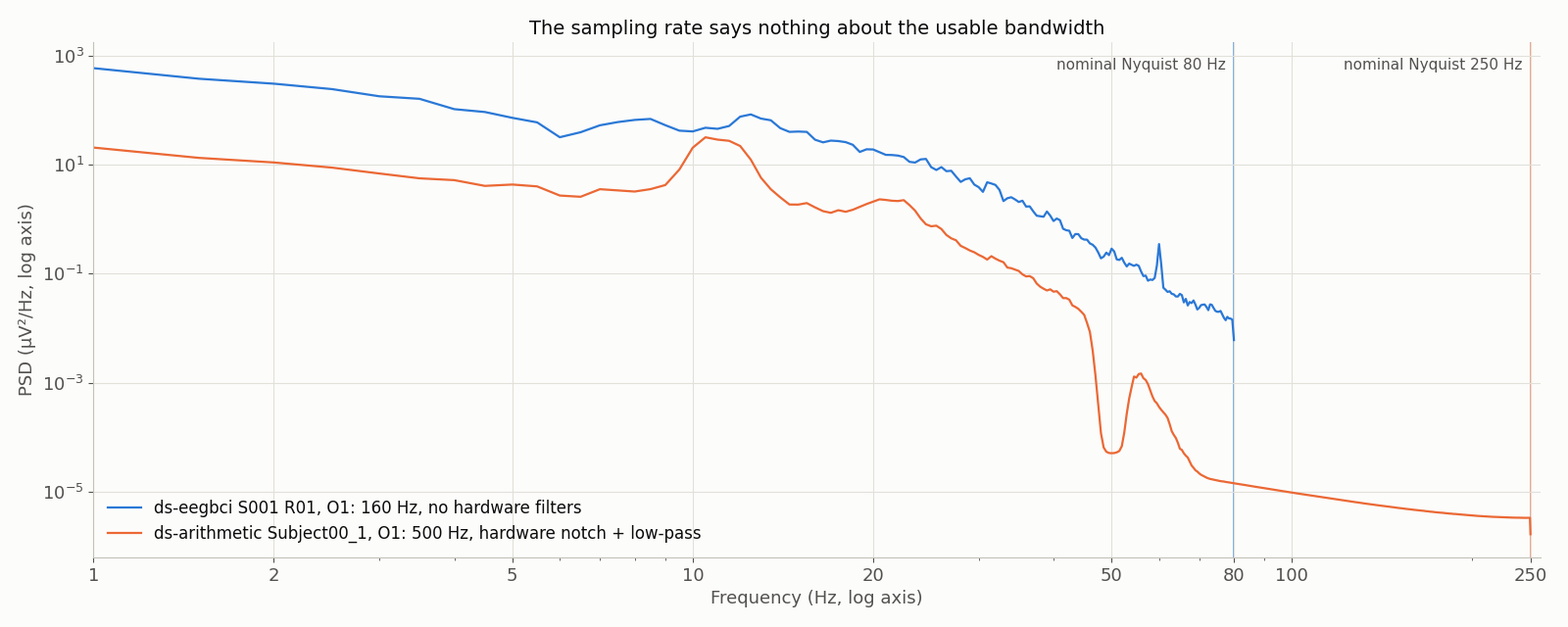
ds-eegbci S001 R01 (O1, 160 Hz, no hardware filters) against ds-arithmetic Subject00_1 (O1, 500 Hz, hardware notch and low-pass); Welch PSD, 2-s Hann segments. The higher sampling rate offers a 250 Hz Nyquist frequency, but the hardware has already removed everything above roughly 30–45 Hz; analysing “gamma” there would analyse the noise floor. Generated by data/scripts/make_figures.py (ODC-By 1.0 for both datasets).